
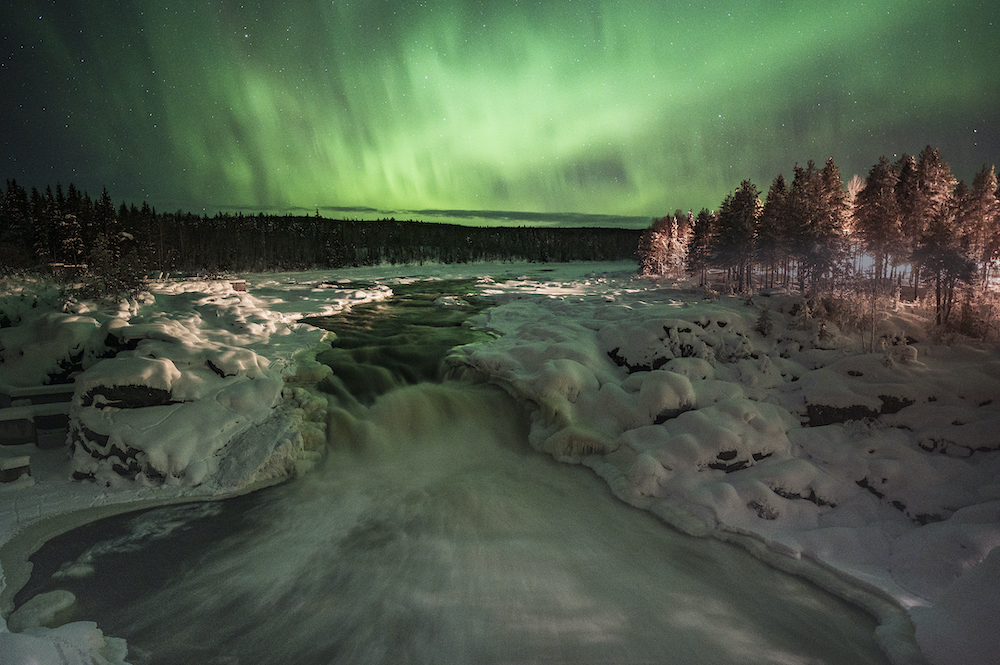
Immerse yourself in a magical world where night is transformed into a celestial tableau vibrant with captivating colors. The aurora borealis, the dancers of the sky, invite you to live an extraordinary experience, an enchanting embrace between Earth and space.
Scientific" magic
Origin of solar particles
The aurora borealis results from the interaction between charged solar particles, mainly electrons and protons, emitted by the Sun during solar flares. These particles are carried along by the solar wind, a constant flow of charged particles through interplanetary space.
Earth's magnetic field
When solar particles reach the Earth's magnetosphere, the region around the planet influenced by its magnetic field, they interact with molecules of oxygen, nitrogen and other gases in the Earth's atmosphere.
Ionization of atmospheric gases
During this interaction, charged solar particles ionize atmospheric gases, i.e. they strip electrons from atoms and molecules.
Light emission
When the electrons are returned to their orbit around the atom's nucleus, energy is released in the form of light.
This light is visible as magnificent bands of color in the night sky.
The characteristics of the aurora borealis
A palette of colors
The aurora borealis often displays colors such as green, pink, violet and red. These colors depend on the type of ionized atmospheric gases and the altitude at which the reactions take place.
Moving shapes
The northern lights are not static. They can appear as undulating curtains, arcs of light or crowns, constantly changing across the sky as a result of variations in the solar wind and the movement of ionized particles in the Earth's magnetosphere.
Geographical location
Aurora borealis are generally observed in regions close to the polar circles, such as the Arctic and Antarctic, although aurora australis can also be observed in the southern hemisphere.
The appearance of the aurora borealis is the result of a magnificent dance between charged solar particles, the Earth's magnetic field and atmospheric gases, creating an enchanting light show in the polar night sky.
The myths surrounding this phenomenon
The northern lights have captured the imagination of people down the centuries, and many myths and legends have emerged to try and explain this mystical phenomenon.
Some famous myths
Lights in the sky
Some native North American cultures interpret the Northern Lights as fires lit by spirits in the sky. According to these legends, the spirits dance and play ball with a human head, creating the colorful lights in the sky.
The lights of the ancestors
Aboriginal peoples of the Far North, such as the Inuit, have often associated the aurora borealis with the spirits of their ancestors. Some believed that the aurora were the souls of the deceased, who returned to the sky to communicate with the living.
Creative foxes
In Finnish mythology, the northern lights are said to be created by foxes running through the snow, scattering snow across the sky with their luminous tails. The aurora borealis are the result of this activity.
The dancing valkyries
Norse mythology sometimes refers to the northern lights as the reflection of the armor and shields of the valkyries (the warrior maidens serving Odin), who dance in the sky to honor fallen heroes.
Portals to other worlds
Some myths suggest that the aurora borealis are portals to parallel worlds or alternate dimensions. Some aboriginal peoples believed that passing through an aurora could transport a person to a spiritual realm.
Divine warnings
In some cultures, the northern lights were interpreted as divine warnings. For example, the Saami, an indigenous people of the Arctic region, considered the aurora borealis to be a sign of coming misfortune, such as disease or war.
These myths and legends bear witness to the fascination and respect that cultures the world over have always had for natural phenomena, seeking to give poetic and mystical meaning to the mysteries of the universe.
When can you see the northern lights in Swedish Lapland?
The dance of the northern lights is a spectacular spectacle that we frequently enjoy in Swedish Lapland. Contemplating the Northern Lights is both a breathtaking and mystical experience. But when is the best time to see the northern lights in Swedish Lapland? The lights rapidly change from hesitant, barely visible veils to glittering cones, seemingly covering the whole sky.
It may be a myth, but many people also claim to have heard the Northern Lights at their most intense.
As a rule, the aurora borealis produces no noise perceptible to the human ear. Auroras are the result of the interaction between charged solar particles and the gases of the Earth's atmosphere, and this interaction manifests itself mainly in the form of light.
However, there are anecdotal reports of people claiming to have heard noises associated with the aurora borealis, such as whistling, crackling or similar noises. Such observations are rare and not fully understood scientifically.
Some researchers suggest that if such sounds are actually heard, they could be linked to distinct atmospheric phenomena, such as variations in the earth's ionosphere or electromagnetic disturbances. However, this remains a relatively mysterious area of research, and there is no clear consensus on the existence or cause of these possible aurora-related sounds.
In short, although the northern lights are primarily a visual spectacle, it's not entirely out of the question that some people may have perceived associated sounds. However, such experiences remain rare and are not part of the common experience of aurora observers.
One thing's for sure: it's a unique experience to witness and a fabulous souvenir to take home from Swedish Lapland. The celestial luminous phenomenon, the Aurora Borealis, is simply described as the result of the interaction between solar winds and the Earth's magnetic fields.
When is the best time to observe?
Ideally, the best time to observe the Northern Lights is between September and the end of March, although we've seen them as early as the end of August.
The lights can appear anywhere it's dark, but the best times seem to be between 9pm and 2am.
Another factor is light pollution in all its forms, from street lamps to the full moon.
Of course, the weather can also affect light observation.
September, October and November have steadily increasing hours of darkness and the advantage of not yet being really cold in many snow-free regions.
For those who dream of a dramatic, snowy backdrop, with the Northern Lights dancing above, December and January are the perfect times to observe these lights. The long nights add to the splendor of this experience.
In February and March, the days are longer and the weather is milder, but still very snowy. During the day, you can enjoy snow-covered landscapes under the increasingly strong sun, and in the evening, you can catch a glimpse of the northern lights.
What are the chances of seeing this show during your trip?
Although there's no guarantee that you'll see the Northern Lights, your chances increase the longer you stay in the area. Stay away from streetlights and check your chances online with one of the Northern Lights forecast apps or on a website such as Space Weather.
Some weeks, you can witness fantastic displays, repeated several times each evening, for many consecutive days. At other times, clouds and snow prevent the Northern Lights from appearing.
Of course, the longer you stay and explore Swedish Lapland, the better your chances of experiencing this incredible view, especially north of the Arctic Circle, at high altitude, preferably in an open space with no other light sources.
But remember, no matter where you are in the region, a clear winter's night gives you every reason to look to the sky.
When you finally see the Northern Lights, it's a moment you'll never forget. But beware: once you've seen them, you'll want to see them again and again!
How to take photos of the Northern Lights?
Photographing the Northern Lights can be a rewarding experience, but it requires a certain amount of preparation and specific night photography skills. Here are a few tips for successful aurora photography.
A good location
The aurora borealis is most frequent near the magnetic poles. Places like Alaska, Canada, Norway, Sweden, Finland and Iceland often offer good viewing opportunities.
Weather conditions
Choose clear nights with few clouds to maximize your chances of seeing and photographing the Northern Lights.
Light pollution
Find a location away from city lights to avoid light pollution, which will ensure sharper, higher-contrast images.
A stable tripod
To capture sharp images during long exposures, a stable tripod is essential. Make sure it's firmly positioned on stable ground.
A device in manual mode
Set your camera to manual mode for total control over the parameters. Use an aperture (f/2.8 or lower) and shutter speed (usually between 5 and 20 seconds) suited to the brightness of the aurora.
Also consider increasing ISO sensitivity to capture more detail in low-light conditions. You can start with a moderate ISO value (800 to 1600) and then adjust as required.
Manual focusing
Auto focus may not work properly in the dark. Use manual focus, setting your lens to infinity to ensure maximum sharpness.
Don't forget the batteries!
Cold conditions can shorten your camera's battery life more quickly. Bring extra batteries and keep them warm by storing them in an inside pocket.
Patience above all
Finally, be patient and ready to adjust. The northern lights can appear and disappear just as quickly. Be ready to adjust your settings as light intensity changes.
Consider integrating landscape into your photos to give perspective and context to the northern lights. This can include mountains, lakes or trees.
Don't forget that patience and practice are essential to capturing great northern lights photos. Take the time to familiarize yourself with your equipment and experiment with different settings to get the best results.
A cell phone as camera?
It's entirely possible to take pictures of the Northern Lights with a cell phone, but it can be a challenge due to the limitations of some smartphones in terms of manual control of camera settings. However, with constant advances in smartphone technology, many models now offer enhanced night photography options.
Here are some tips for capturing the Northern Lights with a smartphone.
Activate night or low-light mode
Some smartphones feature a night mode or special functions for low-light environments. Use this mode to improve image quality in low-light conditions.
Remember also to reduce the brightness of your phone screen to avoid any negative impact on your adaptation to darkness during aurora viewing.
No flash
Make sure the flash is deactivated, as it can interfere with the natural luminosity of the aurora borealis.
Stabilize your phone
Using a tripod to stabilize your phone, or alternatively leaning it against a solid surface, will help avoid motion blur caused by shaking your hand while shooting.
Disable digital zoom
Using the digital zoom often results in a loss of image quality. It's best to crop the photo after shooting.
Apply manual focus
Some smartphones allow manual focusing. Set the focus to infinity to capture the Northern Lights in sharp focus.
Think third-party applications
Some third-party photography applications offer advanced features, including the ability to manually adjust camera settings. Explore these applications for more flexibility.
Avoid stray light
Try to minimize light pollution from surrounding lights by moving away from artificial light sources.
Bear in mind, however, that the quality of the results will largely depend on your phone's camera capabilities. Newer, high-end models generally perform better in low-light conditions.
Don't hesitate to experiment with your phone's features to get the best possible results.